I was going to asked why 21n^2n wasn’t simplified to 21n^3, but I now realize that 1 was an l. (and then I flashed back to the freshman calculus class I taught where someone simplified (sin x)/x = sin.)
It’s stuff like that that made me always do a cursive l when I did math. And put a line through my zs.
Mary Pat – that was way to much information! But can you tell me the square root of a right triangle times the widith of a 3 year old Oak Tree in a Moutain Range 3 Million Years old, time the radius of a quadrilateral’s 5th dimention, plus all of space and time divided by X?
If math is a foreign language, then I’m using the tourist dictionary. I do good just to use the basic functions of the whole mess. I’m still trying to figure out how I passed high school algebra with a B…I don’t remember getting grades that high!
What Mary said. I used to write the “ln” in cursive to indicate natural log to keep things clear. Anyway, I don’t remember that equation at MIT. We didn’t advance into chicken math.
Anon 11:47 – no there shouldn’t. This is a series, meaning you substitute a number where you see an m on the lefthand side of the equation, starting at m=3 and going to m=(n/2). You add up each substitution. Thus, on the righthand side (the sum of the series) there shouldn’t be any m’s, just n’s.

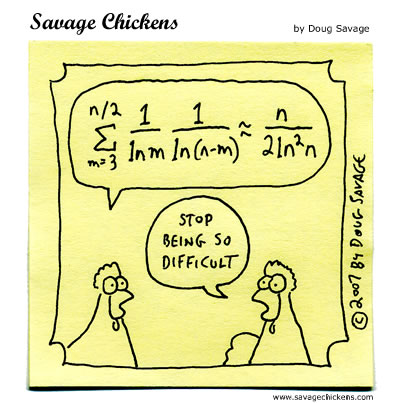



I was going to asked why 21n^2n wasn’t simplified to 21n^3, but I now realize that 1 was an l. (and then I flashed back to the freshman calculus class I taught where someone simplified (sin x)/x = sin.)
It’s stuff like that that made me always do a cursive l when I did math. And put a line through my zs.
Wow. wouldn’t conversation be amazing if it was like that.
‘I say Roger, the Sum total of 1 over 1 to the minus n multiplied by 1 to the minus n’ is equal to just 1 don’t you know?’
‘Why no! How very intersting. How very interesting squared infact…’
Mary Pat – that was way to much information! But can you tell me the square root of a right triangle times the widith of a 3 year old Oak Tree in a Moutain Range 3 Million Years old, time the radius of a quadrilateral’s 5th dimention, plus all of space and time divided by X?
If math is a foreign language, then I’m using the tourist dictionary. I do good just to use the basic functions of the whole mess. I’m still trying to figure out how I passed high school algebra with a B…I don’t remember getting grades that high!
The answer is 42.
What Mary said. I used to write the “ln” in cursive to indicate natural log to keep things clear. Anyway, I don’t remember that equation at MIT. We didn’t advance into chicken math.
Something’s wrong with the look on that chicken’s face…
She’s hallucinating!
Shouldn’t there be an m on the right hand of the equation or did I miss it in the chicken scratch writing of the equation?
Anon 11:47 – no there shouldn’t. This is a series, meaning you substitute a number where you see an m on the lefthand side of the equation, starting at m=3 and going to m=(n/2). You add up each substitution. Thus, on the righthand side (the sum of the series) there shouldn’t be any m’s, just n’s.
Thanks for a nerdy comic Doug!
regarding the similarity of conversation and unsolvable equations:
guy: “I’m fine”
translation: “I’m fine”
girl: “I’m fine”
translation: “I’ll get you for this you bastard…”
ugh! we’re doing that right now in calculus! curse you calculus! you follow me everywhere!!!