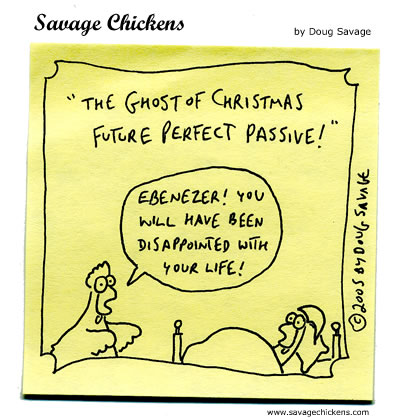
Great cartoon, as usual. However, as an English teacher, I have a nit to pick. I’m afraid it’s really not the Future Perfect Passive. It’s the Future Perfect Active (“will have been”) along with the past participle adjective (“disappointed”). This use of the past participle adjective is called the “stative passive”, but the verb itself is active voice.
So the ghost should moan, “The life you will have had will be disappointing”? Please don’t make the poor chicken diagram the sentence. Please, noooooooo.
Now, I’m imagining the ghost of an English grammar teacher, showing an overhead of the 10 basic sentence patterns, grasping at dangling modifiers and gleefully splashing red ink everywhere.
Dear Teresa, Well, I DID say it was nitpicking. But I can’t help myself. Actually, though, having one of the Savage Chickens try to diagram a sentence might be a worthy subject for Doug to consider. After all, sentence diagrams are mostly “chicken-scratching”, anyway. Regards and Merry Christmas, John P.S. By the way, although the number of basic sentence patterns in English is not firmly established, your “10” is one of the foremost contenders.
1) Absolutely hilarious! 2) Dear English Teacher: I grant your point about participles, which are widely misdiagrammed, but is this not the way that English FORMS the future perfect passive? If not, please conjugate ‘be disappointed’ into the future perfect passive for me. – A Classicist
Dear tealizzy, Well, a true passive construction indicates that an action is performed on the subject of the sentence, whereas a stative passive construction merely describes the state or condition of the subject. So, to change the sentence to a “true passive” all that needs to be done is to add an agent: “Ebenezer! You will have been disappointed by all the wrong choices you have made in your life.” Admittedly a bit more verbose than the original, but heck, if you want a “true passive”, you have to make sacrifices. Regards and Merry Christmas P.S. If Doug wanted to feature an even more bizarre tense, he could have used the Future Perfect Progressive Passive: “Ebenezer! When I come again, you will have been being disappointed for quite some time by all the wrong choices you have made in your life.”
That’s beautiful. Seven years later, this is making the rounds on Facebook, and I nitpicked it too, although I didn’t know the fanciest terms for the fanciest passive. 🙂
it’s f’ing perfect, whether the grammer is or not. I love it. as a newly started english teacher I find I haven’t got a clue if it is or if it is not. great cartoons all. love scott
This cartoon seems to be making the rounds again this year, and what I really love about it is that I’ve drawn comics about religion, sex, politics, etc, but the comics that generate the most controversy are ALWAYS the grammar ones.
And I think that’s pretty fantastic. Because I’m an editor in my day job, I often wonder if anybody cares about good grammar any more. So thanks for the comments!
For the record, I know that this isn’t quite future perfect passive voice. Sometimes I fudge things like this because I think it makes the joke work better. For example, I know that starfish are actually called sea stars but I ignored this so that the joke would work better. I hope you grammar junkies can still enjoy this cartoon, even if it isn’t entirely accurate! 🙂




Perfect! On Christmas day I will have been amused for four days!
Yay! I was wondering how long it would take before i saw at least one thing to do with “A Christmas Carol”. =P
This is hysterical! I sent it to all my English-major friends from college days.
Must…tell…grammar….joke….
Woman jumps into a cab at Boston’s Logan airport and tells the driver, “Take me someplace I can get scrod.”
Driver turns around and says, “No one’s ever asked for it in the pluperfect subjunctive before.”
The holidays make a lot of people tense.
So, try other tenses!
Brilliant!
Great cartoon, as usual. However, as an English teacher, I have a nit to pick. I’m afraid it’s really not the Future Perfect Passive. It’s the Future Perfect Active (“will have been”) along with the past participle adjective (“disappointed”). This use of the past participle adjective is called the “stative passive”, but the verb itself is active voice.
My head hurts. Some present!
So the ghost should moan, “The life you will have had will be disappointing”? Please don’t make the poor chicken diagram the sentence. Please, noooooooo.
Now, I’m imagining the ghost of an English grammar teacher, showing an overhead of the 10 basic sentence patterns, grasping at dangling modifiers and gleefully splashing red ink everywhere.
Dear Teresa,
Well, I DID say it was nitpicking. But I can’t help myself. Actually, though, having one of the Savage Chickens try to diagram a sentence might be a worthy subject for Doug to consider. After all, sentence diagrams are mostly “chicken-scratching”, anyway.
Regards and Merry Christmas,
John
P.S. By the way, although the number of basic sentence patterns in English is not firmly established, your “10” is one of the foremost contenders.
I don’t get it 😀
1) Absolutely hilarious!
2) Dear English Teacher: I grant your point about participles, which are widely misdiagrammed, but is this not the way that English FORMS the future perfect passive? If not, please conjugate ‘be disappointed’ into the future perfect passive for me.
– A Classicist
It could, after all, be a periphrastic, no?
Dear tealizzy,
Well, a true passive construction indicates that an action is performed on the subject of the sentence, whereas a stative passive construction merely describes the state or condition of the subject. So, to change the sentence to a “true passive” all that needs to be done is to add an agent:
“Ebenezer! You will have been disappointed by all the wrong choices you have made in your life.”
Admittedly a bit more verbose than the original, but heck, if you want a “true passive”, you have to make sacrifices.
Regards and Merry Christmas
P.S. If Doug wanted to feature an even more bizarre tense, he could have used the Future Perfect Progressive Passive:
“Ebenezer! When I come again, you will have been being disappointed for quite some time by all the wrong choices you have made in your life.”
That’s beautiful. Seven years later, this is making the rounds on Facebook, and I nitpicked it too, although I didn’t know the fanciest terms for the fanciest passive. 🙂
Wow!
And I thought I was a grammar nut.
You have all been being putting me to be have been shamed…
this is a winner, doug. ranks high up there.
it’s f’ing perfect, whether the grammer is or not.
I love it.
as a newly started english teacher I find I haven’t got a clue if it is or if it is not.
great cartoons all.
love scott
Oh my God, I love this.
Wow, I definitely think that Doug should try to incorporate “Future Perfect Progressive Passive” – Aggressive into a cartoon! 😀
Why will I have am going to feel the need to mention Dr Streetmentioner?
This cartoon seems to be making the rounds again this year, and what I really love about it is that I’ve drawn comics about religion, sex, politics, etc, but the comics that generate the most controversy are ALWAYS the grammar ones.
And I think that’s pretty fantastic. Because I’m an editor in my day job, I often wonder if anybody cares about good grammar any more. So thanks for the comments!
For the record, I know that this isn’t quite future perfect passive voice. Sometimes I fudge things like this because I think it makes the joke work better. For example, I know that starfish are actually called sea stars but I ignored this so that the joke would work better. I hope you grammar junkies can still enjoy this cartoon, even if it isn’t entirely accurate! 🙂